pvpltools.module_efficiency.fit_efficiency_model#
- pvpltools.module_efficiency.fit_efficiency_model(irradiance, temperature, eta, model, p0=None, **kwargs)[source]#
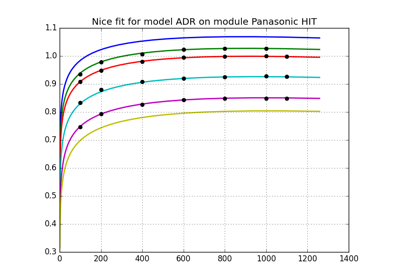
Determine the parameters of a module efficiency model by non-linear least-squares fit.
This is a convenience function that calls the scipy curve_fit function with suitable parameters and defaults.
- Parameters:
irradiance (non-negative numeric, W/m²) – The effective irradiance incident on the PV module.
temperature (numeric, °C) – The module operating temperature.
eta (numeric) – The efficiency of the module at the specified irradiance and temperature.
model (function) – A PV module efficiency function such as adr. It must take irradiance and temperature as the first two arguments and the model-specific parameters as the remaining arguments.
p0 (array_like, optional) – Initial guess for the parameters, which may speed up the fit process.
kwargs – Optional keyword arguments passed to curve_fit.
- Returns:
popt (array) – Optimal values for the parameters so that the sum of the squared residuals of
model(irradiance, temperature, *popt) - etais minimized.pcov (2-D array) – The estimated covariance of popt. See curve_fit for details.
- Raises:
(These errors and warnings are from curve_fit.) –
ValueError – if either ydata or xdata contain NaNs, or if incompatible options are used.
RuntimeError – if the least-squares minimization fails.
OptimizeWarning – if covariance of the parameters can not be estimated.
See also
pvpltools.module_efficiency.adr,scipy.optimize.curve_fitAuthorAnton Driesse, PV Performance Labs